
Nebraska Data Center Resources Hub
Nebraska is open for business and recognizes the economic opportunities new industry can bring, including expanded local tax bases, job creation, and community investment. At the same time, responsible development requires balancing economic growth with the protection of Nebraska’s resources and ensuring that appropriate safeguards are in place to support affordable energy and sustainable use of natural resources for future generations.
Established by Governor Pillen’s Executive Order No. 26-17, the Data Center Task Force recognized the importance of enhancing access to reliable information to support informed, fact-based decision-making regarding data center development across the state.
The Nebraska Data Center Resources Hub provides information about key aspects of the data center development process, including planning and zoning, water, energy, and other environmental permitting considerations. The purpose of this resource is to provide reliable, centralized information that enhances public transparency and helps counties, municipalities, and community members make informed decisions that reflect their present and future priorities, while maintaining local control. It also highlights practical examples from real Nebraska communities.
The Resources Hub is organized into sections that offer foundational background information, external resources, and a comprehensive FAQ. Together, these materials promote informed conversations and support transparency around how data center development may impact Nebraska’s infrastructure, natural resources, and local communities.
Planning and Zoning
In Nebraska, state law authorizes counties and municipalities (cities or villages) to regulate land use through zoning. Each exercises this authority within its respective jurisdiction.
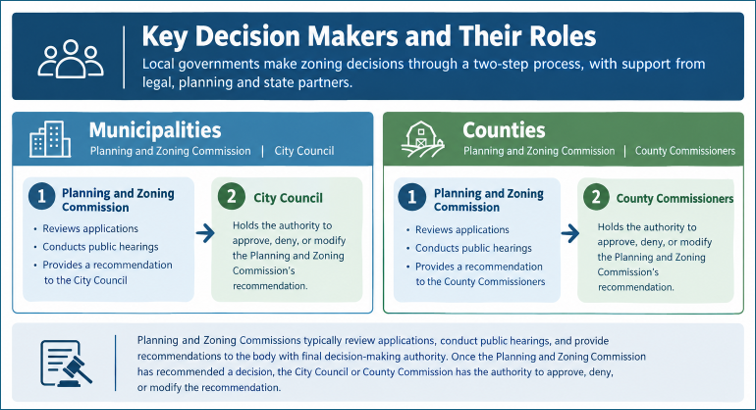
For cities and villages, the zoning authority generally extends to land within their corporate limits and, where applicable, certain surrounding areas known as extraterritorial jurisdiction (ETJ). County zoning authority generally applies to areas outside the zoning jurisdiction of cities and villages within the county. However, not all Nebraska counties have adopted zoning regulations.
Zoning regulations vary among communities because they are designed to address local conditions, needs, and priorities. Local zoning regulations must be consistent with the community’s adopted comprehensive development plan and applicable state law. Nebraska statutes identify goals for zoning that include promoting public health, safety, and general welfare, as well as the economic stability of the community.
Zoning and land use decisions are ultimately made at the local level by the governing body with jurisdiction over the property. These decisions generally involve a process that may include review by local planning and zoning officials, consideration by the local governing body, and opportunities for public input, as illustrated in this graphic.
Data Center Planning and Zoning: A Hypothetical Example
A local zoning ordinance may require a proposed data center to obtain a conditional use permit (CUP) before development can proceed. A CUP allows a local government to evaluate a proposed land use on a case-by-case basis to determine whether it is appropriate for a particular location and whether potential impacts can be adequately addressed.
Depending on the requirements of the local ordinance, the review may consider factors such as:
- Site suitability: Whether the proposed location is appropriate for the development.
- Infrastructure capacity: Whether roads, water supplies, electricity, and other infrastructure can support the development.
- Land use compatibility: Whether the proposed use is compatible with surrounding properties and existing land uses.
- Community impacts: Potential effects on public health, safety, and neighboring properties, and the surrounding community.
A CUP may also allow a local government to impose reasonable conditions for a proposed development to address potential impacts and protect neighboring properties and the broader community. The specific review criteria and conditions depend on the applicable local zoning regulations.
Nebraska Examples:
The following local regulations provide examples of how Nebraska communities address data center development through zoning and supplemental development standards:
City of Kearney Code:
- Chapter 14 – Zoning District Regulations, Section 14-112 (Use Matrix: Levels of Permitted Uses)
- Chapter 46 – Supplemental Use Regulations, Section 46-105 (Development regulations specific to data centers – site development, sound, water and sanitary sewer, air quality and emergency generation and operational performance standards and procedures)
- City of Kearney Code Chapter 46 – Supplemental Use Regulations, Section 46-105 (Development regulations for sound including standards for noise and vibration, low-frequency and tonal noise, and sound-level limits at the property line)
Lincoln County Zoning Regulations:
- Article 4, Section 4.07 (Land Use Categories Matrix)
- Article 8, Section 8.22.03 (Data Center Facilities Requirements)
Water
Water Management in Nebraska
Nebraska manages its water resources based on the source of the water (groundwater or surface water), with different regulatory authorities and requirements depending on the source and location of use.
Groundwater is managed locally by Nebraska’s 23 natural resources districts (NRDs). State law grants NRDs specific authorities to manage and protect groundwater, including the ability to adopt rules and regulations tailored to local conditions. As a result, groundwater management requirements can vary across the state depending on the NRD and the area’s groundwater conditions.
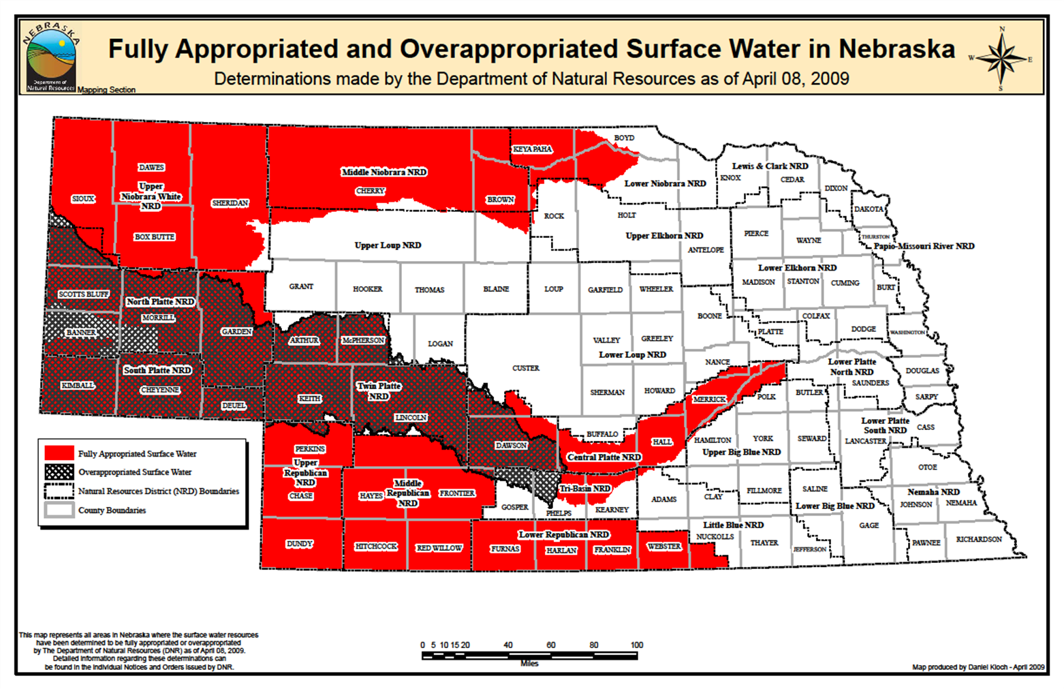
Surface water is managed by the Nebraska Department of Water, Energy, and Environment (DWEE), which administers the state’s surface water appropriation and permitting system. DWEE also maintains the state’s groundwater well registration system.
Water availability varies significantly across Nebraska. Certain river basins and portions of the state have been designated as fully appropriated or overappropriated, meaning water supplies are subject to additional management controls. Depending on the location, these controls may include restrictions on new uses, water allocations, and requirements to measure and report water use.
In addition to general groundwater management requirements, many NRDs have established permitting or approval requirements for “large water users” within their respective jurisdictions. These requirements were adopted to address the demands of significant municipal, industrial, and other water users and generally predate the recent growth of data center development. [Placeholder for link to summary sheet?]
Data Centers and Water Use
Like other commercial or industrial facilities, data centers may obtain water from different sources depending on their location and operational needs. To date, existing data centers in Nebraska obtain their water through local public water utilities. These utilities may supply water from groundwater, surface water, or a combination of both. A data center served by a public water system is generally subject to the utility's applicable requirements, rather than obtaining an individual water appropriation or groundwater well permit for the water supplied by the utility.
The amount of water a data center uses can vary significantly depending on its size, cooling technology, facility design, and operating conditions. Some facilities use closed-loop cooling systems that recirculate water within the system, reducing the need for a continuous supply of additional water. Other cooling technologies may require more frequent or continuous water replenishment. Water use can also vary based on climate, operating demands, and other site-specific factors. It is also important to distinguish between water withdrawal and water consumption.
Water withdrawal refers to the total amount of water taken from a source, while water consumption refers to the portion of that water that is not returned to the original water source, such as water lost through evaporation. As a result, the amount of water a data center withdraws may differ from the amount it ultimately consumes.
Data Center Water Use: Hypothetical Examples
The following examples illustrate how water-related requirements may differ depending on how a proposed data center obtains its water.
| 1. Municipal Water System | 2. Groundwater Source | 3. Surface Water Source |
|---|---|---|
A data center plans to locate in or near a city and connect to the city’s municipal water system. The data center would be subject to applicable requirements established by the municipal water provider, including any applicable connection, capacity, or permitting requirements. The utility may evaluate whether its existing water supply and distribution infrastructure, as well as wastewater infrastructure, can accommodate the proposed development. If additional capacity is needed, improvements could include larger water mains, additional pumping or storage capacity, or other infrastructure upgrades. Utilities may also use applicable rates, fees, or separate service agreements to account for the costs of serving large water users and ensure that the costs associated with new development are appropriately allocated. | A data center plans to construct a new groundwater well to supply its operations. The proposed well would be subject to applicable state well registration requirements and the rules and regulations of the local NRD. Depending on the location and proposed use, additional requirements may include well permits, large water user permits, water-use measurement, or other groundwater management controls. Groundwater management requirements vary among NRDs and may be more restrictive in areas experiencing groundwater quantity or quality concerns. | A data center plans to obtain water directly from a surface water source, such as a river or stream. The proposed use would be subject to applicable state laws and DWEE regulations governing surface water appropriations. Depending on the circumstances, the project may need to obtain a new surface water appropriation or meet the requirements associated with an existing water right. The availability of surface water for a new appropriation depends on the location and applicable water management requirements, including whether the basin or area is fully appropriated or overappropriated. |
In addition to the water-related requirements described above, a proposed data center may also be subject to locally adopted zoning regulations, conditional use permit requirements, or supplemental development standards addressing water supply, water conservation, or wastewater capacity. These requirements vary by jurisdiction.
Nebraska Examples:
NRD Rules and Regulations for Groundwater Management
The following examples illustrate how NRDs address groundwater wells and large water users through locally adopted rules and regulations:
- Nemaha NRD: Management Area Rules and Regulations for Groundwater Quantity Management Areas, Chapter 5 (Water Well Permits), Section 5.11.
- Papio-Missouri River NRD: Groundwater Rules and Regulations, Chapter 4 (Water Supply Well Permits), Section 4.1.5.
- Upper Big Blue NRD: Rules and Regulations for the Enforcement of the Groundwater Management and Protection Act, Rule 5, Chapter 7 (Large Volume Water User Permits).
Local Regulations
- City of Kearney: Code Chapter 46 – Supplemental Use Regulations, Section 46-105 (Development regulations requiring a water and wastewater feasibility study that must conclude the proposed data center will not materially or adversely impact local water systems or wastewater systems).
- Lincoln County Zoning Regulations: Section 8.22.04 (Data Center Development Standards requiring a closed loop or recycled water system).
Water Use Comparisons Placeholder [info from Kearney webpage]
- Nebraska Golf Course – Average 4.3 to 5.5 million gallons per hole per year
- Splash Pad
- Average Household
- Pivot
- Peak demand of City of Lincoln
- Peak demand of City of Kearney
Electricity
Nebraska’s Public Power System
Nebraska is unique in that it is the only state served entirely by publicly owned electric utilities. Unlike many states where electricity is primarily provided by investor-owned utilities operating on behalf of shareholders, Nebraska’s electric system is made up of public power districts, municipal electric systems, electric cooperatives, and public power agencies. These entities operate on a not-for-profit basis and are governed by locally elected or appointed boards.
Nebraska’s public power framework emphasizes local accountability, with utilities responsible for providing reliable electric service to their customers while managing costs and maintaining the infrastructure necessary to meet current and future demand.
A key component of Nebraska’s electric system is the Nebraska Power Review Board (NPRB), which reviews certain proposed electric generation and transmission projects and performs statewide electric system planning and coordination functions.
Nebraska also participates in the Southwest Power Pool (SPP), a regional transmission organization that coordinates electricity movement, grid reliability, wholesale electricity markets, and transmission planning across all or portions of 17 states. Participation in the SPP allows Nebraska utilities to coordinate with a broader regional electric system, providing access to additional generation resources and transmission infrastructure. This regional coordination helps support reliability during extreme weather, equipment outages, and periods of high electricity demand.
Local governing bodies and public power utility boards also play an important role in evaluating new development. Their responsibilities may include considering infrastructure capacity, service requirements, financial commitments, applicable regulations, and potential impacts on existing customers and the surrounding community.
Data Centers and Electricity Demand
Data centers can require significant amounts of electricity to operate servers, cooling systems, and other supporting infrastructure. Electricity demand varies depending on the size of the facility, its computing capacity, cooling technology, and operational requirements.
Large new electric loads may require substantial investments in generation, transmission, and distribution infrastructure to ensure that sufficient electricity is available and can be reliably delivered. Depending on the location and size of the proposed development, these improvements may involve new generation resources, transmission lines, substations, or upgrades to existing infrastructure.
Nebraska has adopted legislation and public power utilities have implemented processes to address the growth of large electric loads while protecting existing customers and maintaining system reliability.
Recent Nebraska Legislation
The following laws establish additional requirements and protections related to large electric customers and the costs associated with serving them:
- LB1010 (2026) – Large Load Customer Regulation Act: Establishes requirements for large electric customers with a peak electric demand of 20 megawatts (MW) or more. Among other provisions, the law requires large load customers to pay for distribution and substation improvements necessary to serve their electric demand. Public power suppliers may also establish rates, charges, and operating standards for large load customers to fairly allocate the costs associated with providing service.
- LB1261 (2026): Provides additional protections for Nebraska ratepayers in connection with very large industrial loads. For an industrial customer with a new electric load greater than 1,000 MW, the law limits a consumer-owned utility’s ability to use eminent domain to acquire a privately developed generation facility that is built to serve that customer, provided specified conditions are met. These conditions include NPRB approval, a long-term contractual arrangement with the applicable consumer-owned utilities, and the industrial customer paying all costs, fees, congestion fees, and electric system upgrade costs incurred by the consumer-owned utility as a result of the project.
Other Environmental Permitting
Data center development and operation may be subject to other environmental permitting requirements depending on the facility’s design, equipment, activities, and potential environmental impacts. Such requirements may include water discharge permits and air quality permits administered by DWEE.
Water Discharges
The National Pollutant Discharge Elimination System (NPDES) permitting program, administered by DWEE, helps protect Nebraska’s waters from pollution by regulating the discharge of pollutants from point sources. Generally, facilities must obtain an NPDES permit when they discharge pollutants from a point source into waters of the state. Permits establish discharge limits and other requirements designed to protect water quality. Permit holders may also be required to monitor discharges, maintain records, and submit reports to demonstrate compliance.
For data centers, the need for an NPDES permit depends on the type of wastewater generated, how it is managed, and where it is discharged. For example, cooling systems may generate wastewater, such as cooling tower blowdown, that requires appropriate treatment and disposal.
Many facilities may discharge wastewater to a local sanitary sewer system, rather than directly to surface waters. In those circumstances, the facility may be subject to requirements established by the local wastewater utility, including applicable capacity, discharge, and pretreatment requirements.
If wastewater is discharged directly to surface waters, an NPDES permit may be required.
Data centers may also be subject to stormwater permitting requirements during construction or operation. Construction stormwater permits may be required depending on the size and scope of the construction activity, while certain industrial activities may trigger additional stormwater permitting requirements.
Air Quality
Nebraska’s air quality program, administered by DWEE, helps protect public health and the environment by regulating air emissions from certain facilities and activities. DWEE administers the state's air quality permitting program under the federal Clean Air Act and Nebraska law.
Whether a facility needs an air quality permit depends on the types and amounts of air pollutants it has the potential to emit, as well as the equipment or activities at the facility. Air quality permits may establish emission limits, operating requirements, monitoring requirements, and reporting obligations.
Potential sources of air emissions associated with data center development and operation may include:
- Emergency generators and other engines: Combustion emissions from diesel or natural gas-powered generators used for backup electricity.
- Boilers and heating equipment: Emissions from equipment used to heat buildings or support facility operations.
- Fuel storage and handling: Potential emissions associated with fuel storage tanks and related equipment.
- Construction activities: Dust and particulate emissions associated with site preparation, construction, and other activities.
Although data centers generally have relatively limited direct air emissions from their primary computing operations, backup generators and other combustion equipment can be significant sources of air emissions and may trigger permitting requirements.
For a data center, the need for an air quality permit and the applicable requirements depend on factors such as the number and size of generators, fuel type, hours of operation, potential emissions, and facility location.
Data Center Air Quality: Hypothetical Example
A proposed data center may need an air quality construction permit before construction begins if its potential to emit (PTE) exceeds the thresholds established in Title 129 Neb. Admin. Code Ch. 3, § 001.03 (Nebraska Air Quality Regulations).
For data centers, the primary sources of air emissions are typically diesel-powered emergency generators, which may emit pollutants such as nitrogen oxides (NOx).
Under Title 129, a state air quality construction permit may be required for the construction, reconstruction, or modification of a facility when the net increase in potential emissions equals or exceeds the applicable thresholds for regulated pollutants.
The following table identifies the applicable potential emission thresholds.
Whether a construction permit is required depends on the facility's overall potential emissions and applicable permitting provisions. Additional federal or state air quality requirements may also apply depending on the facility and its equipment.
| Pollutant | Construction Permit Trigger (tons per year) |
|---|---|
| PM10 | 15 tpy |
| PM2.5 | 10 tpy |
| SO2/SO3 | 40 tpy |
| NOx | 40 tpy |
| VOC | 40 tpy |
| CO | 100 tpy |
| Lead | 0.6 tpy |
| Single HAP | 2.5 tpy |
| Combined HAPs | 10 tpy |
Data Center Resources Hub: LB1010 (2026) Data Center Report Information
Nebraska Data Center Information Map
Data Center Resources Hub: Links
Disclaimer: The following resources have been compiled for informational and reference purposes only. The inclusion of an external resource does not constitute endorsement, recommendation, or approval by the Nebraska Department of Water, Energy, and Environment or the State of Nebraska.
| Organization | Resource Link |
|---|---|
| Nebraska Department of Water, Energy, and Environment (DWEE) | Environmental Permits in Nebraska National Pollutant Discharge Elimination Systems (NPDES) Program |
| Nebraska Association of County Officials (NACO) | NACO Land Use Permit Toolkit |
| Nebraska Planning and Zoning Association (NPZA) | Nebraska Planning Handbook: Second Edition |
| Nebraska Association of Resources Districts (NARD) | NARD – Find Your Natural Resources District |
| Nebraska Chamber of Commerce | Placeholder for new study. |
| Nebraska Public Power District (NPPD) | New Load Process OR New Load Process - Overview OR New Load Contacts Waiting for feedback from NPPD on what to include. |
| Omaha Public Power District (OPPD) | Waiting to hear back from OPPD on what they would like included. |
| Lincoln Electric Systems (LES) | Waiting to hear back from LES on what they would like included. |
| Nebraska Legislature | Recently passed legislation related to data centers: |
| City of Kearney, Nebraska | Data Center Regulations Webpage |
| Lincoln County, Nebraska | Data Centers FAQ |
| Southwest Power Pool (SPP) | SPP – About Us |
| Electric Power Research Institute (EPRI) | U.S. Data Center Electricity Use and Power Strategies |
| The National Association of Counties (NACo) | NACo Informational Primer and County Considerations: Data Centers |
| Georgia Energy Policy and Innovation Center (EPIcenter) | Georgia Data Center Ordinance Hub |
| Great Plains Institute (GPI) | GPI Data Center Resource Hub |
| National League of Cities (NLC) | NLC Data Center Factsheet |
| American Planning Association (APA) | Data Centers Evolved: A Primer for Planners |
Data Center Resources Hub: Frequently Asked Questions
A data center is a specialized facility that houses computer servers, data storage systems, networking equipment, and supporting infrastructure used to store, process, and transmit digital information. Data centers vary in size, design, and purpose. Although they have existed for decades, demand for cloud computing and artificial intelligence (AI) has contributed to the development of larger, more resource-intensive facilities. Depending on their design and operations, data centers may require substantial amounts of electricity and specialized cooling systems. The term “data center” may also be defined differently under specific statutes or regulations, depending on factors such as a facility’s intended use or energy demand.
Four common types of data centers include:
| Enterprise Data Centers | Colocation Data Centers | Hyperscale Data Centers | Edge Data Centers |
|---|---|---|---|
| Facilities owned and operated by a single organization to support its internal business operations and information technology needs. Examples include data centers operated by hospitals, banks, university systems, and manufacturing companies. | Facilities that provide space, electricity, cooling, and network connectivity to multiple customers. Customers typically install or lease their own computing and networking equipment within the facility. | Very large facilities, or network of facilities, designed to support extensive computing, storage, and networking demands at scale. These facilities are commonly associated with large cloud computing providers and technology companies. | Smaller facilities located closer to the people, devices, or systems they serve. By processing data closer to its source, these facilities can reduce delays in transmitting information and support applications such as telecommunications and connected devices. |
Data centers are not regulated by a single entity. Instead, multiple state and local authorities may have regulatory responsibilities, depending on a facility’s location, design, and operations.
1. Local zoning and permitting:
Counties, cities, and villages exercise zoning and land-use authority within their respective jurisdictions, subject to applicable state law. Local requirements may determine where a data center can be located and whether additional approvals, such as a conditional use permit (CUP), for example, are necessary.
Through their zoning and permitting processes, local governments may establish applicable requirements concerning setbacks, noise, screening, land-use compatibility, and other site-specific considerations. Building permits and other local approvals may also be required.
Sources: Neb. Rev. Stat. §§ 23-114 to 23-114.06; §§ 23-172 to 23-174.02; §§ 19-901 through 19-933.
2. Natural Resources Districts (NRDs):
NRDs manage groundwater resources within their respective jurisdictions and may adopt and enforce groundwater management rules and regulations. Data centers projects must comply with applicable NRD requirements, including any relevant restrictions on groundwater use.
Source: Neb. Rev. Stat. §§ 46-701 to 46-756 (Nebraska Ground Water Management and Protection Act).
3.State environmental permits:
The Nebraska Department of Water, Energy, and Environment (DWEE) administers state environmental permitting programs that may apply to data center construction or operation. Depending on the project, these requirements may address air emissions, construction or industrial stormwater discharges, wastewater discharges, and other regulated activities.
The permits required for a particular facility depend on its characteristics and activities.
Sources: Neb. Rev. Stat. §§ 84-1504 and 84-1505; Title 119, Nebraska Administrative Code (Rules and Regulations Pertaining to the Issuance of Permits Under the National Pollutant Discharge Elimination System); Title 129, Nebraska Administrative Code (Air Quality Regulations).
A conditional use permit (CUP), sometimes referred to as a special exception, allows a land use that is not permitted automatically within a zoning district but may be allowed if specified conditions are met. A CUP process allows the local governing body to evaluate a proposed use based on applicable zoning regulations and site-specific circumstances. Considerations may include the suitability of the location, infrastructure capacity, compatibility with surrounding land uses, and potential effects on public health and safety.
When authorized by applicable law and local regulations, a CUP may include conditions intended to address potential impacts and protect neighboring properties and the broader community.
Examples of uses that may require a CUP include certain agricultural operations, energy facilities, data centers, and recreational uses in agricultural zoning districts.
A land use moratorium is a temporary measure that suspends certain development approvals while a local government evaluates its planning needs or considers changes to its comprehensive plan or zoning regulations. A moratorium may give a county or municipality time to gather information, engage the public, and determine whether its existing regulations adequately address a proposed or emerging land use.
Data centers may obtain water from different sources depending on their location and operational needs.
To date, all existing data centers in Nebraska obtain water through local public water utilities. The source of that water may be groundwater, surface water, or a combination of both. A facility's water source and the amount of water available to it depend on local water infrastructure and applicable water management requirements.
Water use varies significantly depending on a facility’s size, computing equipment, cooling technology, and operating conditions. Cooling can be a major source of water demand at some data centers, although the amount used varies considerably among facilities. Cooling technologies continue to evolve. Depending on the facility's design, options may include conventional air cooling, closed-loop liquid cooling, direct-to-chip liquid cooling, and other approaches that reduce or eliminate the need for water consumption in cooling systems. Water use also depends on how the selected system operates and the conditions under which it is used.
Local zoning regulations or permitting requirements may address water use, cooling technology, water availability, or related infrastructure considerations. For example, a local government may require a water feasibility study or impose applicable conditions as part of its permitting process.
Data centers are also subject to applicable state and local water management requirements, including NRD groundwater management rules.
Additionally, Nebraska law requires data centers to report annual water usage as part of the applicable annual reporting requirements.
Source: Neb. Rev. Stat. § 70-1506(6).
Members of the public can participate through local planning and zoning proceedings, public meetings, and applicable state permitting processes.
Local decisions: Counties and municipalities must follow applicable public notice and meeting requirements. Depending on the proposed development and local regulations, the approval process may include one or more public hearings where members of the public can provide comments before a decision is made.
State environmental permits: Certain state permitting processes provide opportunities for public notice, review, and comment. The procedures and opportunities for participation depend on the type of permit and applicable state law.
Members of the public can review meeting notices, agendas, proposed projects, and permitting information to learn about opportunities to participate in decisions affecting their communities.
Sources: Neb. Rev. Stat. §§ 84-1407 to 84-1414 (Nebraska Open Meetings Act); §§ 84-901 to 84-920 (Nebraska Administrative Procedure Act)
Nebraska’s environmental permitting programs help protect water quality by regulating certain discharges of pollutants into waters of the state. DWEE administers the National Pollutant Discharge Elimination System (NPDES) permitting program. A facility generally must obtain an NPDES permit when it discharges pollutants from a point source into waters of the state and the discharge is subject to the permitting requirements. For data centers, potential wastewater sources may include cooling tower blowdown and other non-process wastewater. Whether a permit is required depends on the nature of the discharge, where it goes, and the activities involved.
Construction and operation may also involve stormwater discharges that are subject to permitting requirements, depending on the project and applicable regulations. Where required, permits may establish discharge limits, monitoring requirements, recordkeeping obligations, and reporting requirements to help ensure compliance with applicable water quality standards and permit conditions.
Sources: Neb. Rev. Stat. §§ 81-1504 and 81-1505; Title 119 Nebraska Administrative Code (Rules and Regulations Pertaining to the Issuance of Permits Under the National Pollutant Discharge Elimination System)
Data centers may have equipment that emits air pollutants, including stationary engines used for emergency backup power. The applicable air permitting requirements depend on the facility’s potential to emit (PTE) air pollutants and other factors established by Nebraska regulations.
Under Title 129 of the Nebraska Administrative Code, a facility may need to obtain an air construction permit before beginning construction if its PTE meets the applicable permitting thresholds.
Facilities that meet major-source thresholds generally require a Class I operating permit under the Title V program. Other facilities may be subject to Nebraska's Class II operating permit requirements or other applicable provisions.
Air permitting requirements may address emissions from backup generators and other equipment, as applicable. Facilities must comply with the requirements and conditions of any permits they are required to obtain.
Sources: Neb. Rev. Stat. §§ 81-1504 and 81-1505; Title 129 Nebraska Administrative Code (Nebraska Air Quality Regulations)
Noise from data centers is primarily addressed through applicable local ordinances, zoning regulations, and permitting requirements. Depending on their authority and local regulations, counties and municipalities may establish requirements concerning noise, setbacks, screening, sound mitigation, and other site-specific conditions. These requirements may be considered during the development review and permitting process.
The specific requirements applicable to a data center depend on its location and the ordinances and regulations in effect.
Nebraska law establishes cost responsibility requirements for large electric customers to help protect other utility customers from paying for certain infrastructure improvements needed to serve new, substantial electricity demands.
Under the Large Load Customer Regulation Act, large load customers with a peak electricity demand of 20 MW or more are subject to requirements concerning the costs of distribution and substation improvements necessary to serve their load.
Individual utilities may also establish separate rates or contractual arrangements for large load customers, consistent with applicable law and regulatory requirements.
These provisions are intended to ensure that large electricity users bear responsibility for specified infrastructure costs associated with serving their electricity demand.
Sources: Neb. Rev. Stat. §§ 70-2201 to 70-2204 (Large Load Customer Regulation Act)
A community benefit agreement (CBA) is an agreement between a project developer and an eligible community representative intended to establish benefits for the community affected by a proposed development.
Nebraska law establishes community benefit agreement requirements for data centers. These agreements can provide a framework for addressing community priorities and establishing commitments related to a development. The specific requirements, parties, and obligations depend on applicable Nebraska law and the agreement's terms.
Source: Neb. Rev. Stat. § 70-1507(7)(b).
Nebraska law places responsibility for data center decommissioning costs on the data center owner or operator, as provided by statute. In addition to state law requirements, applicable local ordinances may establish additional requirements related to decommissioning, site restoration, or other aspects of facility closure. These requirements may vary depending on the facility's location and the local regulations in effect.
Source: Neb. Rev. Stat. § 70-1506(7).