
State of Nebraska Heating Oil and Propane Program (SHOPP)
SHOPP 2025/2026 Heating Season Highlights
• October 2025 began unusually warm, with temperatures 40 percent above normal for the start of the heating season.
• Residential propane prices averaged 3 percent below the 2024/2025 season and remained highly stable.
• Nebraska entered the season with 362,000 barrels of propane—at the lower end of the five‑year range and 3.5 percent below the previous year’s starting level.
• Despite volatile supplies, Nebraska’s propane prices stayed steady throughout the winter.
• Increased December demand and issues on the Mid-America Pipeline led to a sharp decline in statewide propane supplies—an 80 percent drop to 46,000 barrels in January.
• Propane supplies rebounded in February to December levels and finished March 2026 above the five‑year range.
• Residential heating oil prices averaged 6 percent higher than last winter.
• Distillate fuel supplies began October 2025 at 657,000 barrels—mid‑range for the five‑year history and 25 percent higher than October 2024.
• Distillate fuel supplies remained strong all season, ending March 2026 in the upper half of the five‑year range.
Winter Recap
Nebraska’s 2025/2026 winter was 17.5 percent warmer than normal, reducing heating fuel demand statewide. Only one significant winter storm occurred—a blizzard on March 15. Due to its substantial impact on energy distribution, this report places particular focus on the Mid-America Pipeline incident and its effects on Nebraska’s propane supply.
Mid-America Pipeline Incident
The Mid-America Pipeline, owned by Enterprise Products Partners L.P., supplies propane across the Midwest, including Nebraska. A propane leak on November 27, 2025 in Kansas disrupted regional flows at the start of winter. Repairs were completed by December 3, and service resumed on December 5. However, allocation conditions continued on the pipeline’s eastern leg through December 31, limiting daily withdrawals and reducing supply availability for downstream terminals across multiple states.
Nebraska, a member of the 13‑state Midwest Collaborative, worked with the U.S. Department of Energy to assess potential hours-of-service waivers for propane haulers. On December 17, water contamination was discovered in the pipeline, delaying full restoration and likely extending allocation into late December.
By December 19, many terminals remained shut down or restricted. Carriers from affected regions diverted to Nebraska terminals, increasing out‑of‑state truck traffic, lengthening lines, and extending delivery routes. Several Midwestern states issued temporary hours-of-service waivers to sustain deliveries during the disruption.
Transportation Impacts
The pipeline disruptions created significant transportation challenges, including:
• Lengthy loading queues
• Longer distances to reach available supply
• Missed loading windows and repeated delivery attempts
These delays caused driver hours without product movement, complicating propane deliveries during peak winter demand.
Propane Importance and Risks
Propane heats 7–8 percent of Nebraska homes and is especially important in rural areas. It also supports livestock operations, grain drying, and various industrial needs. Without temporary hours-of-service flexibility during the disruption, delivery delays posed a heightened risk of localized shortages, particularly during periods of extreme cold.
On December 19, the Nebraska Propane Gas Association reported supply concerns at Greenwood linked to increased demand from neighboring states. Sunoco likewise reported low or unavailable product at several Nebraska terminals.
To stabilize deliveries, Governor Pillen issued an hours-of-service waiver on December 22, addressing high demand, longer transportation distances, and widespread distribution system challenges.
Propane Supply and Prices
Nebraska’s propane supplies were highly unstable throughout the season. Supplies began at low levels and fell steadily, declining 80 percent in January before recovering in February. By season’s end, supplies were more than three times higher than the previous year’s ending level. (Figure 1)
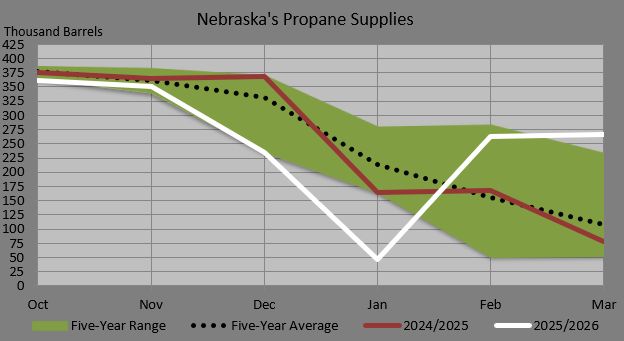
Figure 1. Nebraska’s total propane supply levels compared with the five‑year range and last year’s ending supplies.
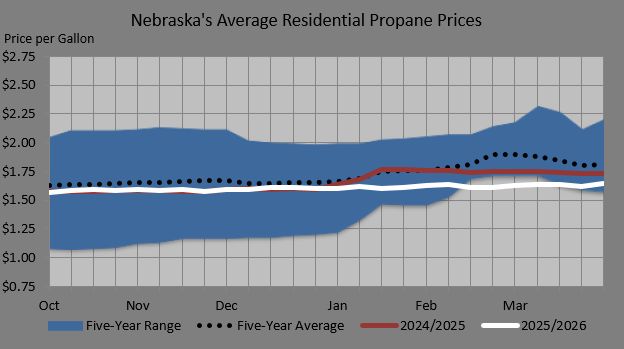
Figure 2. Retail propane prices compared with the five‑year average and five‑year price range.
Retail propane prices during the 2025/2026 heating season remained stable, ranging from $1.57 to $1.64 per gallon—a difference of seven cents. Despite this stability, retail prices did not mirror the volatile propane supply levels throughout the season, nor did they follow the five‑year average price line or the five‑year price range during the latter half of the heating season. (Figure 2)
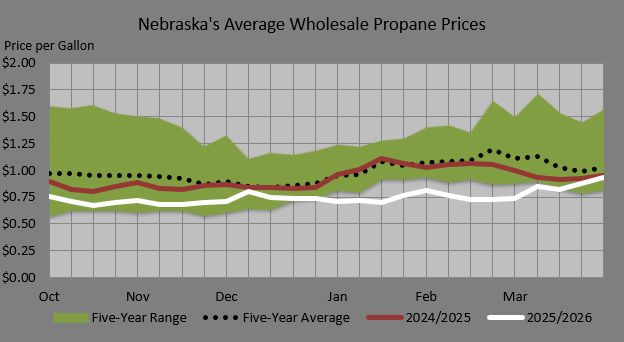
Figure 3. Weekly wholesale propane prices in Nebraska and their position within the five‑year price range.
Nebraska’s average wholesale propane prices were also relatively stable during the 2025/2026 heating season. For most of the first half, wholesale prices remained in the lower portion of the five‑year price range, below both the five‑year average and last year’s prices. At the end of December, wholesale prices dropped below the five‑year price range before rising slightly during the last three weeks of the season, returning to just inside the bottom of the five‑year price range (Figure 3).
Retail propane prices remained remarkably stable despite these fluctuations, ranging only from $1.57 to $1.64 per gallon. Wholesale prices varied more but stayed within a relatively narrow band of 68 to 93 cents. (Figure 4)
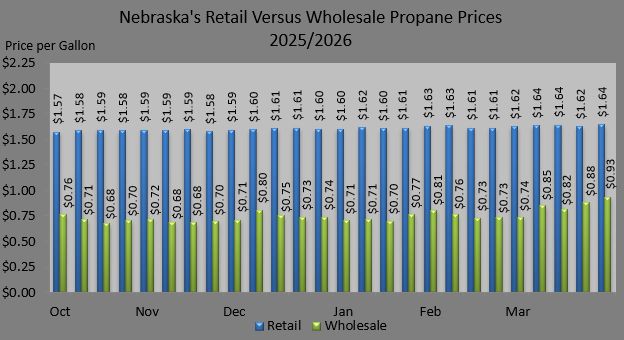
Figure 4. Comparison of Nebraska retail and wholesale propane prices for the 2025/2026 heating season.
Heating Oil Supply and Prices
Heating oil supplies were strong. Supplies started the season 25 percent higher than the previous year and stayed within or above the five‑year average. (Figure 5)
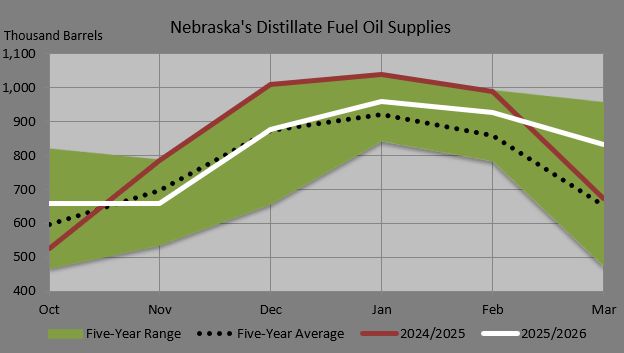
Figure 5. Nebraska distillate fuel supply levels compared with the five‑year average and last year’s supplies.
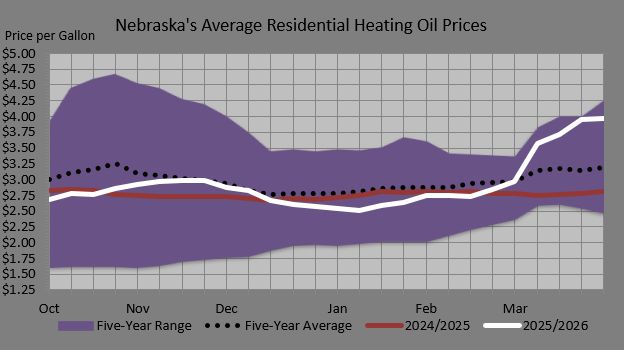
Figure 6. Retail heating‑oil prices compared with five‑year price range.
During the 2025–2026 heating season, average retail heating oil prices were volatile but remained within the five‑year price range. Prices began near the midpoint of the range and fluctuated throughout the season. In March, prices increased notably during the second, third, and fourth weeks, ending the season near the upper boundary of the range. (Figure 6) Retail price movements closely mirrored wholesale price trends. (Figures 6 and 7)
Wholesale heating oil prices showed similar volatility. They aligned closely with retail prices and stayed near the midpoint of the five‑year price range until March. In March, wholesale prices rose sharply in the second and fourth weeks, reaching the upper portion of the range during the second, third, and fourth weeks. By the end of the season, wholesale prices were near the upper boundary of the five‑year price range. (Figure 7)
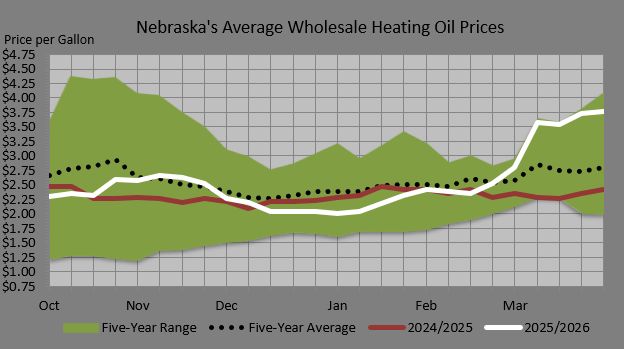
Figure 7. Weekly wholesale heating‑oil prices and their position within the five‑year price range.
Retail heating oil prices showed volatility with sharp increases in March, beginning in October at $2.69 per gallon and ending in March at $3.97—a difference of $1.28. Wholesale prices followed similar trends, rising from $2.30 to $3.76—a difference of $1.46. (Figure 8)
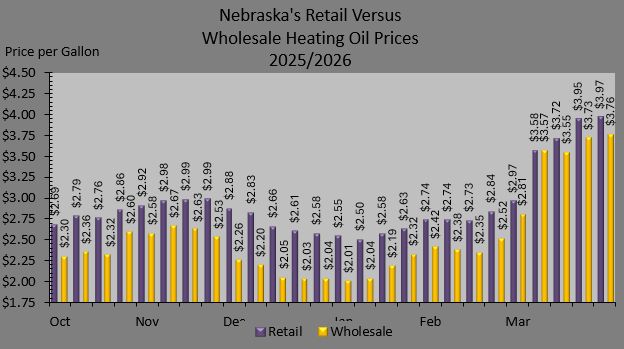
Figure 8. Comparison of Nebraska retail and wholesale heating‑oil prices for the 2025/2026 heating season.
Heating Degree Days
Nebraska recorded 4,507 heating degree days from October through March—17.5 percent below normal. Every month during the heating season was warmer than average, contributing to reduced demand for heating fuels. (Figure 9)
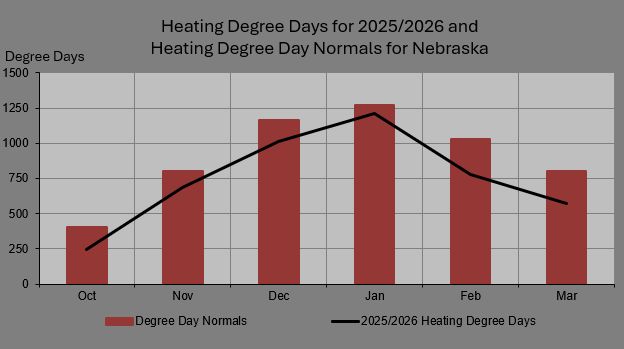
Figure 9. Monthly heating degree days: actual 2025/2026 winter values compared with normal averages.
Purpose of State Heating Oil and Propane Program Survey
The Nebraska Department of Water, Energy, and Environment collects residential heating oil and propane price data through the State Heating Oil and Propane Program (SHOPP). SHOPP is the only Energy Information Administration survey capturing residential propane prices. These data support monitoring of winter fuel conditions and provide crucial information to state and federal agencies, analysts, media, and consumers.
Sources:
Nebraska Average Residential Propane Prices, Nebraska Department of Water, Energy, and Environment, Lincoln, NE.
Nebraska Average Wholesale Propane Prices, Nebraska Department of Water, Energy, and Environment, Lincoln, NE.
Nebraska Average Residential Heating Oil Prices, Nebraska Department of Water, Energy, and Environment, Lincoln, NE.
Nebraska Average Wholesale Heating Oil Prices, Nebraska Department of Water, Energy, and Environment, Lincoln, NE.
This report was completed in September 2026.
| Attachment | Size |
|---|---|
| 2025/2026 | 415.44 KB |