
Generating Capacity in Nebraska by Energy Source
As of 2024, Nebraska had 1,753 generating units with a total of 10,714,400 kilowatts (or 10,714.4 megawatts) capacity.
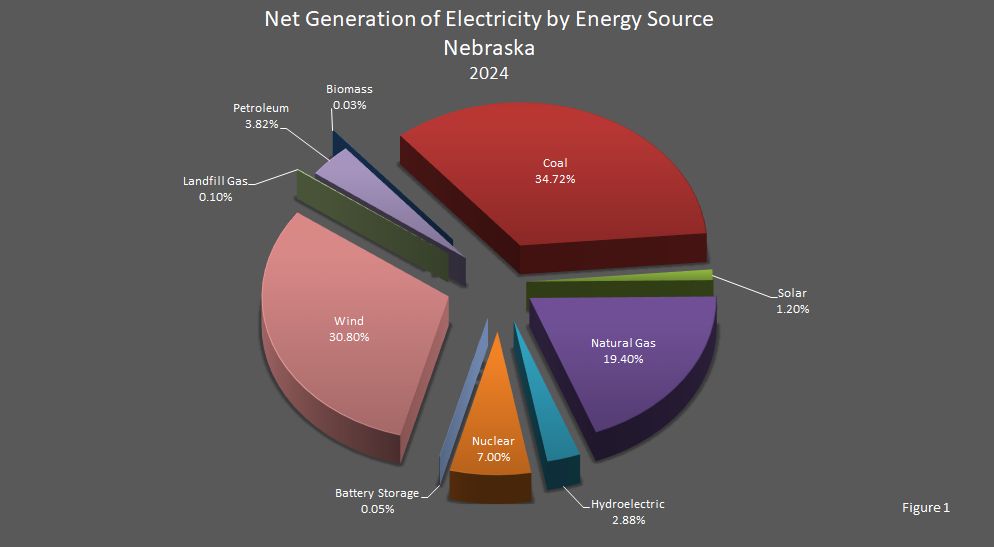
Nameplate capacity came from generators using coal (34.72 percent), wind (30.80 percent), natural gas (19.40 percent), nuclear energy (7.00 percent), petroleum (3.82 percent), hydroelectric power (2.88 percent), solar (1.20 percent), landfill gas (0.10 percent), battery storage (0.05 percent), and biomass (0.03 percent).
Net metered renewable installations are not included in the graph and table since individual projects are not reported; hence, no energy sources are reported.
The Units and Capacity by Energy Source and Year of Initial Operation report, the Generating Units report, and the Annual Electricity Generation report are available for additional information.
A Note About Nameplate Capacity
Summer capacity and winter capacity are sometimes greater than nameplate capacity. The nameplate gives the capacity rating of the generator when it operates at certain temperatures, pressures, and power factors. With some modifications and with some margins that are built into generators, it is possible to exceed its nameplate. It is not uncommon for a generator to exceed its nameplate. The nameplate is usually not replaced and, in this case, the summer and winter capacity is often much higher than the nameplate value. Normally, you expect summer and winter capacity to be below nameplate capacity and in most cases they are.
| Attachment | Size |
|---|---|
| 2024 | 36.61 KB |
Sources: Annual Electric Generator Data. Energy Information Administration, Washington, DC. Nebraska Department of Water, Energy, and Environment, Lincoln, NE.
This report was updated on June 18, 2026.
Typically, there is one year between updates.