
Biomass Energy Generation
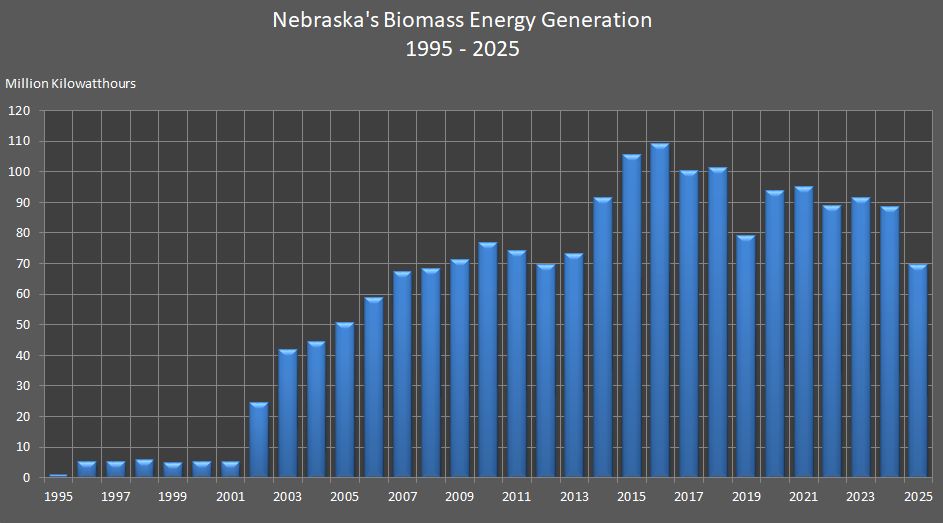
In 2025, the surveyed companies reported that nearly 70 million kilowatthours of electricity were generated by biomass energy in Nebraska, a decrease of 22 percent from the 2024 generation of 88,691,000 kilowatthours (see graph and data table below).
The City of Lincoln and Lincoln Electric System have partnered on the Landfill Gas to Energy Project to harness the methane gas produced at the City of Lincoln's Bluff Road Landfill. The Landfill Gas to Energy Project is a 4.8 megawatt Lincoln Electric System power generating facility fueled with methane gas produced at the City of Lincoln's Bluff Road Landfill. The plant began commercial operation January 1, 2014. The project will provide the area with annual greenhouse gas reductions equivalent to the emissions from about 24,000 cars. To operate the plant, the Lincoln Electric System will purchase about 300,000 million British thermal units (Btu) of landfill gas from the City of Lincoln and use it to produce electricity capable of serving about 2,500 local households. The Lincoln Electric System has agreed to purchase the methane gas recovered from the Bluff Road Landfill and to convert all of the methane gas to electricity.
Butler County Landfill teamed with Aria Energy, which harvests the landfill gas for compressed natural gas that fuels vehicle fleets. Landfill gas is the natural byproduct of the decomposition of organic material in municipal solid waste landfills. As organic waste breaks down, methane gas is created. Landfill methane is normally consumed (incinerated) in a flare rather than being discharged to the atmosphere. The new landfill gas-to-energy initiative provides a renewable alternative to flaring. At Butler County Landfill, a vast majority of the methane gas is harvested through a perforated piping system of 65 drilled gas extraction wells. The captured landfill gas is purified on site into renewable natural gas, which displaces the use of fossil fuels and can significantly reduce greenhouse gas emissions. According to the EPA, the Butler County Landfill project directly reduces emissions from 5,500 tons of methane and avoids nearly 14,000 tons of carbon dioxide emissions per year, the equivalent of removing 600 internal combustion passenger vehicles from the road.
Elk City Station, operated by the Omaha Public Power District, is the first power plant in Nebraska to collect and burn methane to produce electricity. The station started generating electricity from methane in April, 2002. The methane is obtained from the nearby Douglas County Landfill. Elk City Station is a base load unit indicating that it can run year round. Elk City Station completed an expansion and now has a total capacity of 6.2 megawatts. The average annual output could power 4,000 homes.
The City of Omaha operates the Missouri River Water Resource Recovery Facility and the Papillion Creek Water Resource Recovery Facility. The facilities started generating electricity from methane in 1985. The Missouri River Water Resource Recovery Facility added a 1 megawatt generator in 2001 in addition to the existing 1 megawatt generator installed in 1985.
For more information, see Generating Units in Nebraska and the Nebraska Methane Production report.
| Attachment | Size |
|---|---|
| 2026 | 37.37 KB |
Sources: Lincoln Electric System, Lincoln, NE. The City of Omaha, Omaha, NE. Omaha Public Power District, Omaha, NE. Nebraska Department of Water, Energy, and Environment, Lincoln, NE.
This report was updated on November 4, 2026.
Typically, there is one year between updates.